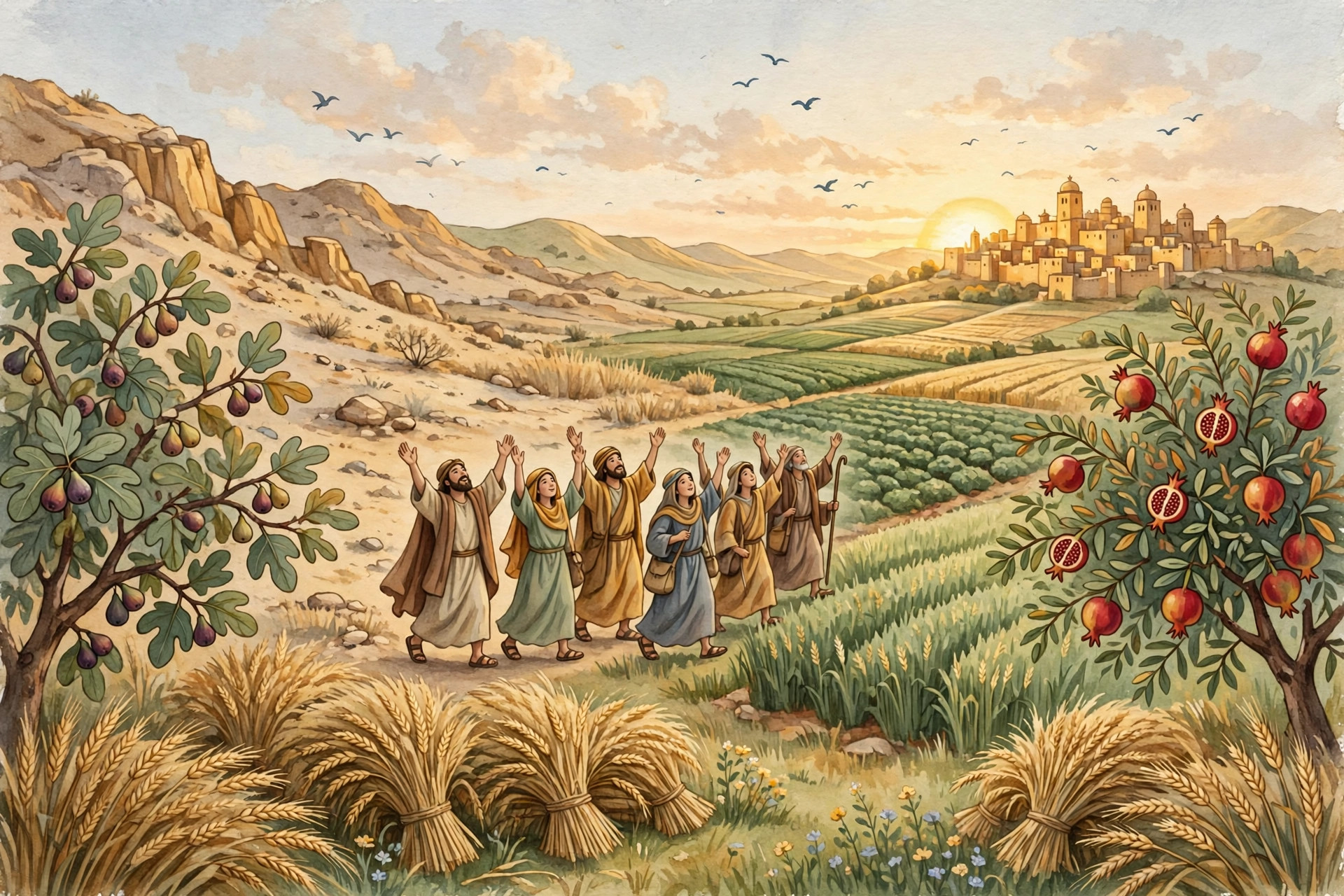
Every November, we practice saying it — around tables, in cards, in the prayer before the meal. Give thanks. But gratitude was never meant to be a seasonal mood, and the Bible’s great thanksgiving psalm does not open with a feeling. It opens with a command:
“O give thanks unto the LORD, for he is good: for his mercy endureth for ever.” (Psalm 107:1, KJV)
The more you sit with this verse, the larger it becomes. Thanksgiving is not one Christian duty among many. In Scripture, it is the most basic response of the redeemed heart to everything God is and everything He has done — the posture from which joy, prayer, and even contentment all grow. And when thanksgiving returns to a life, it has a way of restoring what was broken.
Let the Redeemed Say So
“Let the redeemed of the LORD say so, whom he hath redeemed from the hand of the enemy;” (Psalm 107:2, KJV)
Psalm 107 is a psalm for rescued people. Gathered from the east and the west, from the north and the south (v. 3), the redeemed tell their stories in four refrains: wanderers in the desert, hungry and thirsty, whom God led to a city (vv. 4–9); prisoners in darkness and chains, whom God set free (vv. 10–16); the afflicted at the gates of death, whom God healed with His word (vv. 17–22); and sailors in a raging storm, whom God brought through the calm to their desired haven (vv. 23–32). Four different troubles, one shared pattern: “Then they cried unto the LORD in their trouble, and he delivered them out of their distresses.” (v. 6)
And after every rescue, the same refrain rises, word for word, four times: “Oh that men would praise the LORD for his goodness, and for his wonderful works to the children of men!” (vv. 8, 15, 21, 31). Thanksgiving is what rescued people sound like. It is the native language of the redeemed.
Give Thanks in All Circumstances
Paul carries the same command into the everyday life of the church:
“Rejoice evermore. Pray without ceasing. In every thing give thanks: for this is the will of God in Christ Jesus concerning you.” (1 Thessalonians 5:16–18, KJV)
Notice the small word with the enormous reach: in every thing — not only for every thing. We are not asked to call every circumstance good. We are told that in every circumstance, gratitude is still possible and still God’s will, because the God who is good, whose mercy endures forever, has not left the circumstance. Rejoicing, praying, and thanking are listed together because they belong together: they are the believer’s basic, default response to all of life — not the reward at the end of it.
Paul in Prison: Contentment Grows Out of Gratitude
No one proves this like Paul himself. Last week we looked at what Philippians 4:13 really means — Paul’s confession, written from prison, that he had learned to be content in whatever state he was in, because Christ kept strengthening him. But look at the soil that contentment grew in. In that same chapter, Paul describes how he prayed: “in every thing by prayer and supplication with thanksgiving let your requests be made known unto God” (Philippians 4:6, KJV). And the prison letter itself opens with thanks: “I thank my God upon every remembrance of you” (Philippians 1:3, KJV).
This was no stiff-upper-lip resignation. A man who resents God cannot be content, and a man who only endures his cell will eventually be crushed by it. Paul’s contentment rested on gratitude: before he could rest in his circumstances, he thanked God in them — for the church that loved him, for the gospel advancing even through his chains, for the God who had not abandoned him. The strength Christ gave him to be content was, at its root, a heart that kept giving thanks. Contentment is gratitude that has learned to stay.
Gratitude Restores What Is Broken
Why does thanksgiving carry this much weight? Because its absence is where the breaking begins. Describing how humanity turned away from God, Paul writes that “when they knew God, they glorified him not as God, neither were thankful; but became vain in their imaginations, and their foolish heart was darkened” (Romans 1:21, KJV). The first symptom of the fall was ingratitude — creatures refusing to thank their Creator.
That means gratitude is more than politeness toward heaven. A human being giving thanks to God is the most purely human thing there is: the creature, restored to the posture we were made for, acknowledging the Giver. And what begins to heal when thanks returns is precisely what was broken when thanks was lost. The darkened heart, the anxious mind, the resentful spirit — these are vulnerable places in every one of us, and Scripture treats thanksgiving as one of the most basic elements of their restoration.
A Lecture Hall Confession
Years ago, I sat in a university lecture where the subject was depression — the heaviness that settles over a life until even ordinary days feel impossible. I have never forgotten the word the lecturer offered as the way through it: appreciation. I do not know whether that lecturer was a Christian. But I remember being startled, because he had stumbled onto the same wisdom Scripture has carried all along.
Appreciation does not pretend the darkness is not there. It refuses to let the darkness be the only thing we see. It turns the eyes — slowly, deliberately — toward what has been given: the mercy that met us this morning, the people at our table, the rescues behind us we did not engineer. That is not denial. That is Psalm 107 and 1 Thessalonians 5 practiced one ordinary day at a time: in every thing, give thanks.
Say So
So this Thanksgiving, and on every ordinary day after it, the invitation stands where the psalm put it: Let the redeemed of the LORD say so. Count the rescues, not only the comforts. Thank Him in the circumstance, not only after it. And let the most basic response of the Christian life do its quiet, restoring work in you — for He is good, and His mercy endures forever.
Looking for more verse-by-verse devotionals and daily reminders of God’s Word? Explore our Bible Verse Phone Cases, Phone Grips, Card Holder Wallets, and Key Chains.
Carry this verse with you: Rejoice Always Pray Give Thanks – I Thessalonians 5:16-18 Bible Verse Wallet Phone Case