

“As I walk through the valley of the shadow of death, I take a look at my life and realize there’s nothin’ left.”
In 1995, Coolio’s “Gangsta’s Paradise” carried that line into the ears of an entire generation. Many of us could rap it word for word years before we ever opened a Bible — it just sounded cool. What we didn’t realize is that the line is borrowed. The valley of the shadow of death is not a rapper’s invention. It is David’s, from Psalm 23.
But notice where the two valleys part ways. In the song, a man walks through the valley and takes inventory of a wasted life — alone with his regrets. In the psalm, David walks through the very same valley and says the most astonishing sentence in the chapter: “I will fear no evil, for You are with me.” Same valley. Utterly different walk. David’s psalm is not really about a valley at all. It is about a Companion — the God who walks with His people through life, including its darkest stretch.
And David did not write it from an armchair. He wrote it looking back on a life that included a lion, a giant, a king’s spear thrown at his head, years as a fugitive sleeping in caves, a civil war started by his own son, and his own devastating sin. When that man says, “The LORD is my shepherd; I shall not want,” it is not a slogan. It is a scarred man’s conclusion: I was never once alone.
“The LORD is my shepherd; I shall not want. He maketh me to lie down in green pastures: he leadeth me beside the still waters.” — Psalm 23:1–2 (KJV)
The Shepherd Who Makes Us Lie Down
Notice the small word David uses: my shepherd. Not “the LORD is a shepherd” in general. Mine. Personal. David had been a shepherd boy, so he knew what he was saying: a sheep’s food, water, safety, and direction depend completely on its shepherd. Everything I need, David says, is riding on Him — and He has never failed me.
“He maketh me to lie down.” Shepherds say a sheep will not lie down unless it feels completely safe. Sometimes the Shepherd has to make us rest, because we would never choose it — we graze on anxiously, convinced everything falls apart if we stop. The pastures and still waters are not rewards for well-behaved sheep. They are what a good Shepherd provides, because providing is what He does.
He Restores My Soul
“He restoreth my soul: he leadeth me in the paths of righteousness for his name’s sake.” To restore is to bring back something that wandered off. David knew what it was to be that sheep — he had drifted into places no king of Israel should ever have gone.
And here is the anchor: God leads us in right paths for His name’s sake — not for our résumé’s sake. The Shepherd’s own reputation is on the line. He guides us rightly because of who He is, not because of how well we have followed. If your sense of direction is broken today, His name is riding on getting you home.
In the Valley, “He” Becomes “You”
“Yea, though I walk through the valley of the shadow of death, I will fear no evil: for thou art with me; thy rod and thy staff they comfort me.” — Psalm 23:4 (KJV)
Watch what happens to the grammar of this psalm. In verses 1–3, David talks about God: “He makes me lie down… He leads me… He restores my soul.” But in the valley, David starts talking to God: “for You are with me.” In the darkest place of his life, God stopped being a subject he described and became a companion he addressed. That is what valleys do. Theology becomes company.
And notice: David does not say, “there is no evil.” He says, “I will fear no evil.” The evil is real — but it is a shadow. A shadow, however dark it looks, cannot actually hurt you; the shadow of a dog has never bitten anyone. And a shadow only exists because something real is standing in the light.
The rod and the staff complete the picture. The rod was the shepherd’s club, used to drive off predators — the Shepherd fights for you. The staff was the crook, used to hook a sheep out of a thicket — the Shepherd comes after you. Defense and rescue. Both, David says, are comfort.
And notice what David never claims: he never says the Shepherd keeps His sheep out of valleys. The psalm does not read “if I walk through the valley,” but “though I walk through the valley” — the valley is assumed, not avoided. Sometimes the only road to the next pasture runs straight through it. And in that valley something happens that green pastures cannot do. It is why the Bible calls hardship a refining fire: Peter says our faith is tested by fire the way gold is (1 Peter 1:7) — and fire does not destroy gold. It purifies it. The difficulty we would never have chosen becomes the place where our grip on God, and His grip on us, grows stronger than comfort ever made it.
A Table in Front of Your Enemies
“Thou preparest a table before me in the presence of mine enemies: thou anointest my head with oil; my cup runneth over.” The scene suddenly changes: the Shepherd becomes a Host, and the sheep an honored guest. God does not wait until your enemies are gone to feed you. He sets the table in front of them — the vindication you were going to fight for yourself, He serves as a meal while you sit down. And the cup does not just get filled to the line. It runs over. David’s testimony is not “I barely made it.” It is abundance.
Goodness and Mercy Are Chasing You
“Surely goodness and mercy shall follow me all the days of my life: and I will dwell in the house of the LORD for ever.” — Psalm 23:6 (KJV)
The word translated “follow” is the Hebrew radaph — to pursue, to chase down. It is the same word used when Pharaoh’s army pursued Israel to the Red Sea. All his life, David says, something has been chasing him — and it is not his failures catching up. It is the goodness and covenant mercy of God, pursuing him the way a shepherd pursues a stray sheep: relentlessly, and with every intention of bringing him home.
Which is exactly where the psalm ends: not in a pasture, not even at a table. Home. “I will dwell in the house of the LORD forever.” The wandering sheep ends his story as a member of the household.
The Valley Is Not the Absence of Blessing
So let us be honest about what following the Shepherd means. It does not mean a Christian life with no misfortune and no suffering — David’s biography disproves that on every page. Sometimes it means the opposite: the hardship you actually need is allowed into your life. Not to punish you, but because in the valley your relationship with God is forged the way ease could never forge it. The refining draws you nearer to Him than the pasture did. And you come out the other side discovering something surprising: the hardest chapter became a blessing — not because the valley was good, but because of who walked through it with you, and who you became walking with Him.
Lord, be my Shepherd today. When I cannot see the path, lead me. When I am afraid, stay close. When I wander, come after me. I will fear no evil, for You are with me. Amen.
At Sleeky Case, we believe the words that carry us through the valley are worth carrying every day. That’s why we make daily goods printed with Scripture — so a verse like Psalm 23 can travel with you, and reach the hands of someone walking through a hard season right now.
Browse our Bible Verse Phone Cases, Phone Grips, Card Holder Wallets, and Key Chains — and send a little shepherding to someone you love.
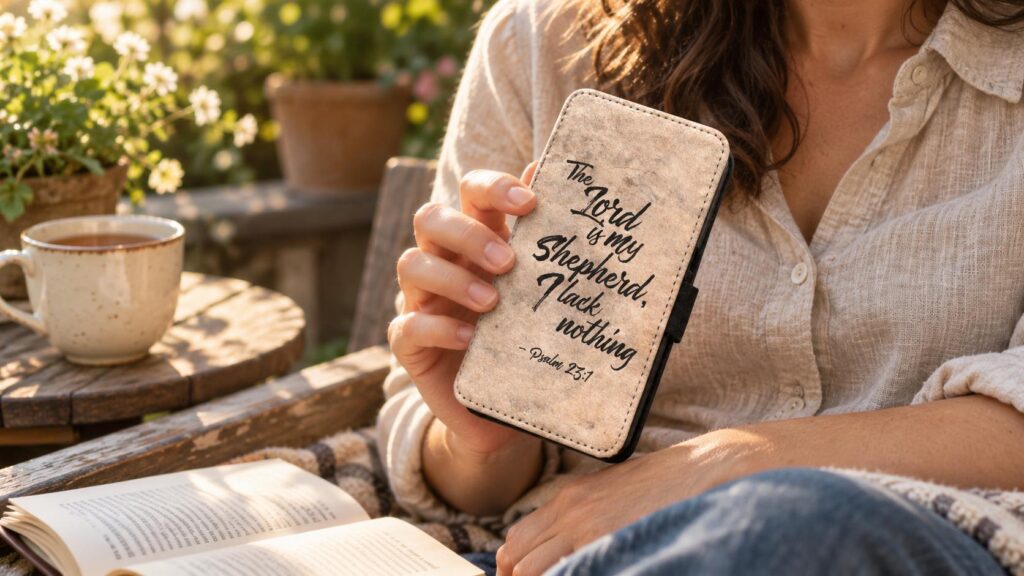
Carry this verse with you: Psalm 23:1 Bible Verse 3D Phone Case – The Lord is my Shepherd